A reusable-packaging startup is raising CHF 2 million. Its pitch promises 60% lower CO₂ emissions than a single-use alternative. It sounds like an attractive circular-economy investment. But what happens if that claim depends on assumptions nobody has independently tested?
Would you invest, or would you ask for evidence first?
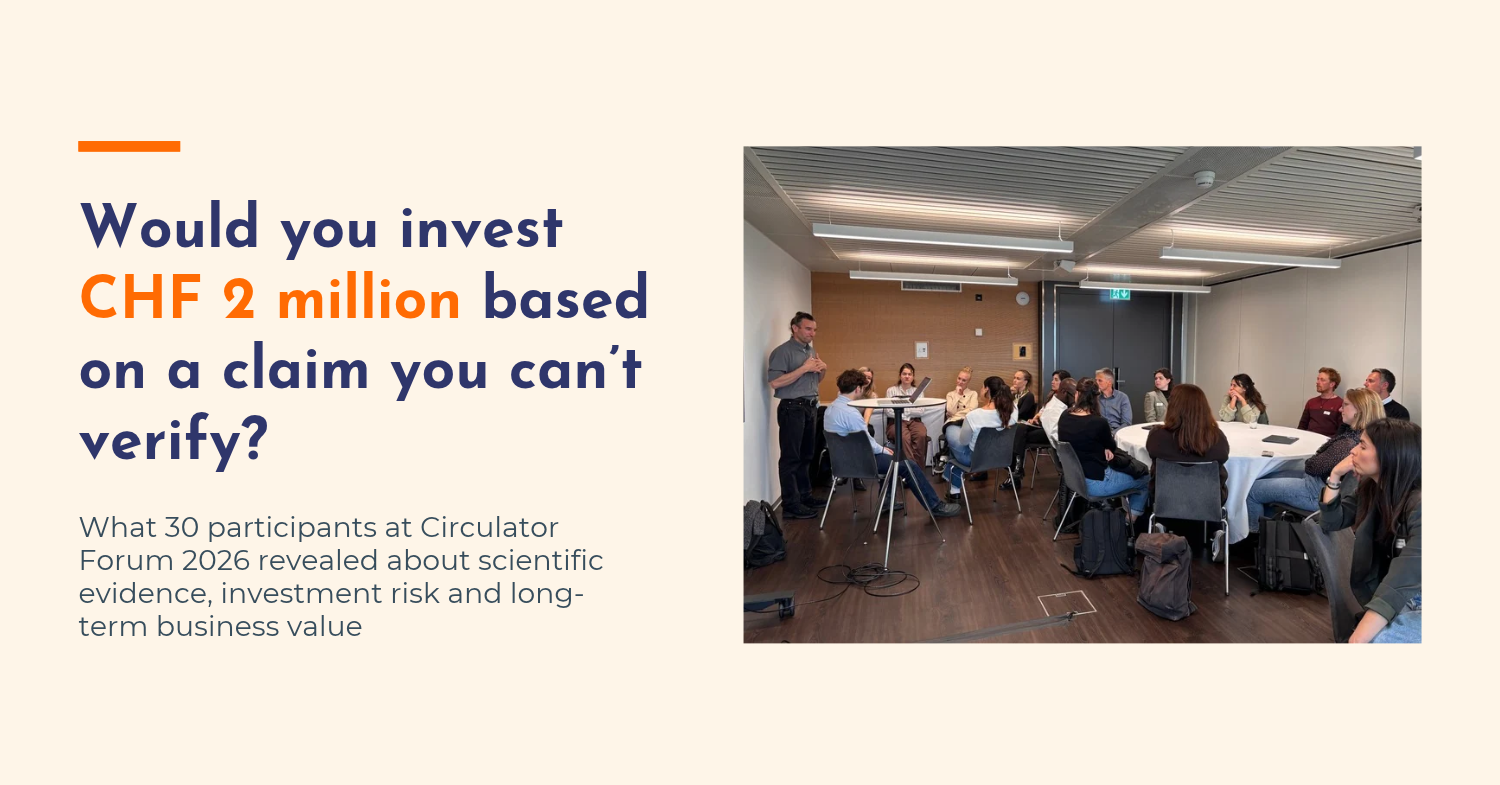
That question set the tone for “Finance & Purpose for Generations: Can You Prove Your Impact?”, our interactive workshop at Circulator Forum 2026 on November 11. The example was hypothetical, but the challenge it raised is real: for investors to make confident decisions, they need to understand both the strength and the limits of the evidence behind a business’s claims.
Not another panel: 30 voices, three conversations
Instead of a sequence of presentations, we divided 30 participants into three groups of roughly ten. Seasoned investors sat alongside industry specialists, entrepreneurs and students. Their different experiences made for a lively discussion about what makes a circular business credible, investable and resilient.
Four contributors connected the perspectives in the room: Dr. Sébastien Humbert of eqlosion brought expertise in Life Cycle Assessment (LCA) and environmental science; Manuel Linder of Impact Gstaad contributed with an investment and circular-entrepreneurship perspective; Lukas Hotz of generational explored responsible ownership and long-term value; and Enrique Alvarado Hablützel, representing eqlosion and Helvora, moderated the exchange and linked evidence to investment decisions.
Each group tackled one question. Together, the discussions made an important point: a compelling impact story is only the beginning of a sound investment case.
1. Scientific evidence: is the impact real or is the story simply convincing?
The first conversation challenged a familiar assumption: a perceived circular solution does not automatically mean environmentally better. A reusable product may perform well in theory, but the actual result depends on how it is produced, transported, used, cleaned, and eventually discarded – in a real-life situation.
Participants explored why independent assessment, appropriate system boundaries, objective comparisons, and real-world operating conditions matter. A life cycle assessment (LCA) can reveal trade-offs that are easy to miss in a marketing claim, for example, whether transport or energy use offsets some of the expected environmental benefit.
Key insight: Before accepting a sustainability claim, investors need to know what was measured, against which alternative, and under which conditions the result holds.
DR. SÉBASTIEN HUMBERT, EQLOSION:
"A perceived circular solution is not automatically a more sustainable solution. A science-based, life cycle assessment, mindset helps us understand what really happens across the entire life cycle, challenge assumptions, strengthen evidence, and identify risks and opportunities associated with a solution."
2. Investment decisions: what would you need to verify before writing the cheque?
The second group quickly moved from environmental performance to investment fundamentals. Is there real customer demand? Has the product been tested? Does the team have the ability to execute? Is the route to market credible, and do the unit economics work?
That connection is important. If a reusable-packaging model needs a certain number of reuse cycles to outperform an alternative, the same threshold may shape return logistics, customer adoption and operating margins. What begins as an environmental appealing story can become a material commercial risk.
Key insight: Scientific evidence should complement commercial, financial and operational due diligence—not replace it. Its role is to make hidden assumptions visible before they become costly surprises.
MANUEL LINDER, IMPACT GSTAAD:
"A compelling impact story can open the door to investors, but a strong investment case needs evidence. By challenging assumptions and understanding the underlying risks, we can make better decisions and help promising circular businesses access the capital they need to grow."
3. Long-term value: how do you scale without losing purpose?
The third group looked beyond the funding round. Which investors and financing structures fit the venture? How can ownership and incentives support its mission? And how do we keep environmental ambition connected to the economics of a growing business?
Environmental baselines and operational KPIs can help answer those questions after investment. Metrics such as reuse rates, emissions per use, resource consumption and losses can guide product improvements, operating decisions and future financing discussions—especially when examined alongside cost and revenue data.
Key insight: Measuring impact is not only about proving past achievements. Used well, it helps management teams and investors decide what to improve next.
LUKAS HOTZ, GENERATIONAL:
"Long-term value creation is about more than securing the next financing round. It requires the right investors, responsible ownership, and a clear understanding of how financial performance and measurable impact can reinforce each other across generations."
The CHF 2 million challenge: when the assumptions change
We brought the three themes together through an illustrative investment case: a venture raising CHF 2 million claimed its reusable packaging could cut CO₂ emissions by 60% compared with a single-use alternative.
The twist was in the details. How many times must the packaging actually be reused? What are the return rates, washing-energy requirements, transport distances and product losses? Would the claimed benefit still hold under less favourable operating conditions? Are there other reusable packaging on the market that can perform even better than the one under scrutiny?
Those are not merely technical questions. They affect the economics and scalability of the company. For an investor, the next step is to turn the assumptions into evidence-backed thresholds and management KPIs—not to accept or reject the pitch on the headline figure alone.
What the room taught us about investment risk
The multigenerational mix was more than a nice feature of the session. Experienced investors contributed financial discipline and practical risk questions. Industry experts tested the operational realities. Entrepreneurs brought the urgency of building viable businesses. Students challenged assumptions and asked what responsible capital should achieve over time.
Different perspectives converged on a practical message: better evidence makes for better questions—and better questions can lead to better investment decisions.
From evidence to investment value
For private equity firms, family offices and venture capital investors, the opportunity extends across the investment lifecycle:
- PROVE IMPACT — Test environmental claims, establish credible baselines and identify trade-offs before relying on a sustainability narrative.
- DE-RISK INVESTMENTS — Combine scientific findings with financial and commercial due diligence to expose assumptions, assess material risks and set clearer investment conditions.
- CREATE VALUE — Translate environmental insights into operational KPIs that can help portfolio companies improve efficiency, competitiveness and readiness for future financing or exit.
Scientific evidence cannot remove investment risk or guarantee a valuation premium. However, by identifying & quantifying risk, it can, improve decision quality and help identify operational improvements whose financial value can be demonstrated rather than merely asserted.
ENRIQUE ALVARADO HABLÜTZEL, EQLOSION:
“Impact is not what we claim. It is what we can demonstrate. Scientific evidence helps us understand our solutions better, reduce risk, build trust and create lasting value.”
That is the principle guiding our work at eqlosion. We believe environmental measurement is most powerful when it becomes part of investment intelligence: informing due diligence, strengthening portfolio businesses and supporting more credible long-term value creation.
Thank you to everyone who joined the conversation at Circulator Forum, and especially to Manuel Linder and Lukas Hotz for helping make it an open, practical exchange across generations and disciplines.
Want to test the claims behind your next investment?
Contact Enrique Alvarado Hablützel at enrique.hablutzel@eqlosion.ch to discuss how scientific evidence can strengthen your due diligence and portfolio value.